Can Dogs Actually Watch TV? The Science Behind Levi’s Safari Training
Can Dogs actually enjoy a good movie?
A.K. Smith
2/28/20263 min read
[Born Free (1966) Blu-ray/DVD/Digital] – "If you want to test your own dog’s 'safari instincts,' here is the classic we watched. $2.99 to rent"
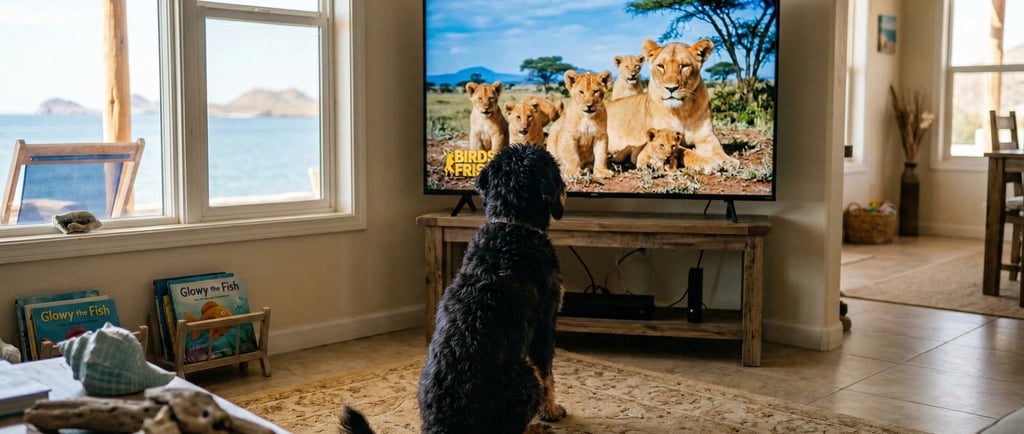
If you follow my newsletter, you know that things are getting a bit "wild" at our house. With our trip to Kenya coming up this June, we’ve been prepping in the most logical way possible: showing our Whoodle, Levi, the 1966 classic Born Free.
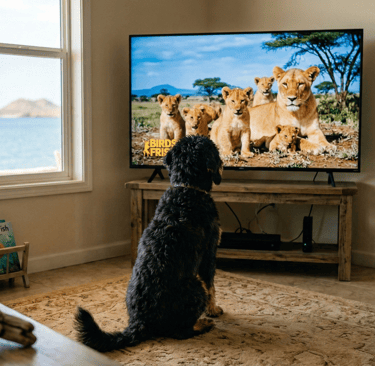
Watching Levi watch those baby lions was pure comedy. He was locked in, head-tilting at every cub squeak, and by the time the credits rolled, he was absolutely exhausted. It looked like he’d actually run the savannah himself! But it raised a question I get asked all the time: Can dogs actually see what’s happening on that screen, or is Levi just humoring my movie choices?
It’s All About the "Flicker"
The short answer? Yes, Levi is definitely seeing the lions—but it’s only because of modern technology.
Back in the day of "tube" TVs (CRTs), your dog probably didn’t care about the screen. This is due to something called Flicker Fusion Frequency. Humans process images at about 60 frames per second (Hz). Older TVs refreshed at roughly that same rate, so to us, the motion looked smooth.
Dogs, however, are biological "high-speed cameras." They need about 70 to 80 frames per second to see continuous motion. On an old TV, a dog wouldn't see a movie; they’d see a series of rapidly flickering still images—kind of like a strobe light at a 70s disco. Since most modern 4K and LED TVs now refresh at 120Hz or even 240Hz, dogs can finally enjoy the show without the "glitchy" headache.
The World in Yellow and Blue
While the motion is smooth, the color palette is a bit different for Levi. Dogs have dichromatic vision, meaning they only have two types of color-processing cells (cones) in their eyes, whereas most humans have three.
What we see: A lush green jungle with a bright red sunset.
What Levi sees: A yellowish-brown field under a very vibrant blue sky.
This is why dogs often react more to high-contrast movements than to specific "hidden" details. Those golden lion cubs against a blue sky? That’s high-def heaven for a dog.
Why Does Watching TV Exhaust Them?
You might notice your dog "conks out" after a nature documentary. For dogs, watching TV isn't a passive experience. Their brains are working overtime to process:
Motion Detection: Their eyes are wired to track movement (predatory instinct).
Sound Localization: They are trying to figure out why a lion is roaring from a black box in Phoenix, Arizona.
Cognitive Recognition: Studies show dogs can recognize other dogs and animals on screen, even if they’ve never seen them in person!
The Verdict
Levi wasn’t just staring at the wall—he was genuinely "training" for Kenya. Whether your dog is a TV addict or a total skeptic usually comes down to their breed and personality. Terriers and herding dogs tend to be more "visual," while hounds might just wonder why the TV doesn't smell like anything.
Does your dog have a favorite show? Or do they ignore the screen entirely? Tell me in the comments!
Dog "Movie Night" Snacks If Levi gets exhausted watching TV, other dogs might need a "theatre snack" to keep them occupied.
Pet-Friendly "Popcorn": There are actually healthy dog treats made to look like popcorn for a themed movie night.
✨ Spread the Kindness
While we’re talking about "Big Cats" and big hearts, I’m on a mission to reach 1,000 downloads for my Kindness Ripple campaign! My goal is to spread ocean-themed kindness to kids everywhere through Glowy the Fish.
Can you help me reach the goal? Download your free Kindness Calendar and Award Coupons here. It’s a small ripple that makes a massive wave. And, if you want to help me spread this to a community of children, hit reply AND let me know! It's all free!
Dive in Deep
Beach reads for adults and children.
Connect
sign up for "From THe ISLAND" newsletter
hello@aksmithbook.com
© 2025. All rights reserved.